Thursday, August 26, 2010

Getting Your Tennis Grip Correctly


A.    Forehand Grip
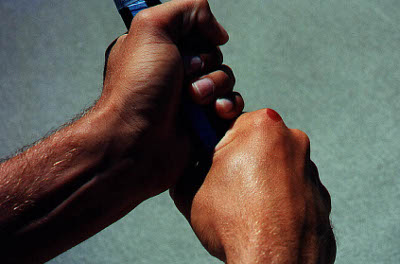
For the forehand grip, place the forefinger knuckle anywhere on or between the third and fourth bevel of the handle.

B.     Backhand Grip
The correct grip, not strength, affects your ability to use a one-handed backhand. Place the forefinger knuckle on the top bevel for topspin and on the second bevel for backspin. Support the racquet by the throat with the other hand between shots.

C.     Two-Handed Backhand Grip
For the two-handed backhand grip, take the serve grip by placing your forefinger knuckle on the second bevel. Then place your other hand above it. 

That is how to get your tennis grip correctly.
read more...

Groundstrokes of Tennis

Groundstrokes of tennis are the basic shot you make once the point has begun.
Although these shots can be played from anywhere in the court, they are usually played from near the baseline and after the ball has bounced.

How you hold the racquet determines how you play the game, so practice your swing and getting your grip correct until you feel comfortable playing these groundstrokes.

• Shots on the forehand side are made with the swing arm moving alongside and away from the body before swinging forward to play the ball.

• Shots on the backhand side are made with the swing arm taking the racquet back across the front side of the body before swinging forward to play the ball.

Two-handed backhand players use combination of these swings.

Groundstrokes of Tennis is one of the best tennis technique to played.
read more...

The Basic Serve of Tennis

The basic serve of tennis starts every point in a match, and the server is considered to have an advantage.
This is partly because you have two changes to get your serve in, and partly because you can take your time to set up the shot and therefore put your opponents at a disadvantage.
They don’t know where you are going to place the shot and therefore have to react quickly. Practice to develop an accurate, reliable serve you can repeat over and over again.

A. Serve Prepare
Make the service grip by holding the racquet with your forefinger knuckle on the second bevel. You should be able to extend the racquet to form an almost straight line with your arm.

B. Serve it up
To begin the serve, stand just behind the baseline near the centre mark, and take a sideway position. Bounce the ball a few time in preparation to serve.

C. Take the shot
Toss the ball high and swing the racquet using a throwing motion, making contact with the ball at the top of your reach.

That is a beginning of the basic serve of tennis or you can read posting before about the basic rules of tennis.
read more...

Basic Rules of Tennis


Basic Rules of Tennis are needed for structure and to allow players to compete on an even basis. For most beginners the rules and system of scoring can seem a bit confusing at first, so learn them as soon as you can to get you started.


Rules of Serving

  • The serve must be played to the diagonal service box.
  • Each game starts on the deuce court, and then alternates from side to side with each point played. The server must stand behind the baseline and between the center mark and the singles sideline for singles or the outer sideline for doubles. The feet can not touch the line or the court before the ball is struck.
  • The server has two changes to get the serve inside the service box. When the serve is made the point begins. If the ball lands inside the box the point continue. If the serve misses, it is called a fault. Two faults are a double fault, which ends the point.
  • When the ball hits the net and lands inside the service box, it is called a let, and the serve is played again.

Rules for Returning

  • The receiver can position themselves anywhere, but ideally near the baseline and sideline on the diagonal side from the server.
  • The receiver must let the ball bounce inside the service box before playing the ball or the point is lost.
  • The receiver player must not deliberately distract the server.

It is the basic rules of tennis for beginner tennis player.
read more...

Tuesday, May 25, 2010

Technique of Holding the Racket (Grip) Perfectly

One of the major keys to play tennis well is the technique of holding the racket (grip) perfectly. There is various ways hold the racket, including the one-handed backhand / forehand and two handed backhand / forehand.

Hold the racket with one hand seems simple but if not done correctly, the results did not blow up. The trick is to place your palms at the end of the racket handle. And thumb in a diagonal position towards the bottom, opposite the rear grip. It would be better if the inside of your thumb, just touch the flat surface of the racket handle.

Hold the racket with two hands. This grip is more difficult than the one-handed grip. The easiest way to do one-handed grip is to hold the racket with a handshake style as comfortable as possible. In order to maximize the results, left hand holding the racket with a forehand grip technique, whereas the position of your left hand above his right hand to push the punch. But it’s depends on the habit.

read more...

Monday, May 24, 2010

Types of Tennis Players

According Ron White (UPSTA), there are two types of tennis players.

Type A

Type A players generally have good technique. Players love to play with this type of style or beauty. On the day they'd play with pretty, covering the entire field and closed the game with his best. These players have at least one type of deadly stroke.

However, Type A players have weaknesses in the mental. Sometimes when playing opponents who do not meet or match the surrounding conditions, such as the type of field or weather does not match, his game became chaotic, In conclusion, if these players are not comfortable playing with, then automatically the game into a mess and it looks from the language of his body or his emotions.
There are some names that could be classified into Type A, like Marat Safin, Goran Ivanisevic or Venus Williams.

Type B

Type B is the type of players who are more "intelligent" than type A. He has no technique is perfect, do not have a lethal weapon, but can read and adapt well in a game. Type B is usually looking for weaknesses or omissions in your opponent. They're like a wall that is very hard to be penetrated so that every ball that hit the opponent can always be restored properly. Consistency, patience and tactics are the capital in defeating his opponents.
This type of tennis pro is like Michael Chang, Lleyton Hewitt, or Martina Hingis.
read more...

Tips : How to Learn Tennis Easily

For adults, this is one obstacle when learning tennis. Presupposes the paper, the field is full of adults. Unlike children who were relieved for 'painted'. Same with tennis in any exercise, you will learn the basic principles and theories play tennis. Basic theory is usually a body position, how to swing rackets in correctly, how to tilt the body, leg position, or when in contact with the ball, and likes. While I understand the basic theory, while learning tennis you also have to train feeling with how to play with a partner, not a wall.

Playing with people will help improve the skills of 'answered' the ball. Feeling and touch are trained will establish a coordination game that is true. If someone has never done sports associated with the game ball, the coach was sometimes first must accustom his students to play 'with the ball. Quickly master the game of tennis later than one depends on the abilities and individual skills. There are fast, some are slow.

Therefore, the cost is very varied, depending on the training ground, a large registration fee. Just as the place to learn to swim, there is a club that just opened for member classes. If you want to learn tennis in it means you have to register to become a member first. Costs also vary widely. There is a system of separate payments for the rental of the field, ball boy, also coaches. Cost also depends on the place, frequency of exercise per week / month, and classes that followed form, semi-private or private.

Average, with the right training techniques, within three months (2-3 times a week exercise) you can already play tennis 'man to man'. To support your stamina, coaches usually also recommend other physical exercises, such as jogging or weight training in the gym. Before buying a tennis racket, you should consult with the coach about the most appropriate racquets. Use of tennis rackets are usually adjusted by the strength (power) and one type of game. We recommend that you practice on the trainer who knows the basic principles of good tennis. Certified tennis players are able to teach proper playing technique. That way you can minimize the risk of injury and technical errors, so that the process of learning tennis easier. You do not have to search for a former coach of a great tennis player. Importantly, the coach is able to transfer knowledge to good practice and you feel comfortable with it.

Let's go play tennis easily.
read more...

Sunday, May 23, 2010

Choosing Tennis Shoes

Want to play tennis well? Notice the tennis shoes you wear. Tennis shoes are part of playing tennis equipment, in addition racket, clothing and tennis balls. How to choose a good tennis shoes, read some tips below :

1. Tennis Shoes Size

Choose tennis shoes that fit your feet. Find the right shoe - really makes your feet comfortable, the model there are several kinds of tennis shoes. There in front of his slightly curved, there is a flat and wide. Make sure the spaces of the toes are not cramped.

2. Materials and Design

Make sure the ingredients / materials soft and comfortable shoes, design shoes specifically for tennis. Do not wear Jogging shoes / other shoe to play tennis, very dangerous for your feet because these shoes are not designed for tennis, a very visible difference in the base design. Tennis shoes are designed flat and the material a little hard to resist and control the balance of the foot while playing.

3. Brand of Shoes

Apparently brand shoes affect your current quality of play. A person who is serious about learning tennis, usually have the Idol. If you idolize the world tennis players, try to notice what brand of shoes they wear.
By wearing the same shoes with your idol, a little more will grow your spirit to work hard and keep the spirit of playing tennis.

Have choosing shoes, increase your confidence!
read more...

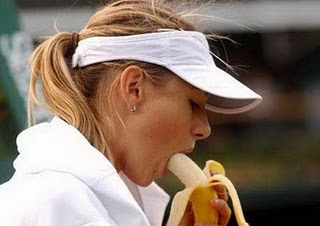
The most of Favorite Nutrition of the World Tennis Athlete is BANANAS!


You must be familiar with William's brothers, the title holder of the world women's tennis match? In addition to the qualified skills, of course, excellent stamina is the key for them to remain superior in the field. Imagine! Sometimes the Williams sisters have played for more than six hours to win the game!
If you carefully pay attention, the most of favorite nutrition of the world tennis athlete is BANANAS! Yes, bananas became a savior to them. Bananas can be easily absorbed by the body and restore their peak energy.

In general, the nutrient content contained in any ripe bananas are as follows: calories 99 calories, 1.2 grams protein, 0.2 fat grams, carbohydrates 25.8 milligrams (mg), 0.7 grams fiber, 8 mg calcium , phosphorus 28 mg, 0.5 mg iron, 44 RE vitamin A, vitamin B 0.08 mg, Vitamin C 3 mg and 72 grams of water.

The content of bananas is enormous, consisting of minerals, vitamins, carbohydrates, fiber, protein, fat, etc., so that if people only ate bananas only, had fulfilled the minimum
nutrition.

Select the Best Qualified Banana!
Pick a ripe banana, a yellowish green skin with patches of brown or yellow, because this will be easy to digest, and fruit sugar naturally converted into glucose rapidly absorbed into the bloodstream, raw banana would be difficult to digest.
read more...

Six Main Factors to be Tennis Champion

Everyone will want to become a tennis champion, a dream for any tennis player who competed in the field, grabbed Trophy Award and Prize Money. With intense competition and the opportunity to continue to grow, then consider the following six main factors. We assure you, the way you become a tennis champion you must reach :

1. Player

As a player, Disciplinary practice, you must obey and follow any directions and guidance from your coach, to put hope and confidence to coach you, then you will continue to thrive. You must continue to practice in the field regularly. Besides, you need discipline to maintain stamina by performing additional sports such as: Jogging, Fitness or Swim.

2. Coaches

The coach would want his students to expand rapidly, continue to grow into a formidable player. Generally, a tennis coach has always taught science based platforms, because it concerns the name and credibility of a coach who incidentally also a former tennis player. Coaches will conduct training programs and guidance to you as much as possible to produce the best performance from within yourself. So choose a coach with experience and you like the training programs.

3. Parents

Your parents are the most important people to support you become a good tennis player and continued to excel. Why are the parents?  Because they were the issuing fund / capital for training costs, transportation costs of capital to spend when he joined the race, which provides everything you need. So, big struggles of your parents need your appreciation, you should appreciate the exercise seriously and strive to reach best performance.

4. Organization

If the three of synergy above: Players, Coaches and Parents has been running fine, the next process is to understand the organizations that manage them.

Besides the parents, coaches must also participate actively provide input, perform cross check and monitor the performance of these organizations. Responsibility to cross check and monitor organization performance are the responsibility of all parents of tennis players.

5. The Motivator or The Mentor

Besides the coach, usually a tennis player to have someone capable of giving spirit bouts. The mentors focus on providing mind set / pattern of thinking as a warrior, a winner and provide support through mental development in the spirit of the game.

John Mc Enroe, Staffy Graff, Roger Federer, Anna Kournikova, Maria Sharaphova, Anna Ivanovic, Rafael Nadal? ... ... They have a mental motivator to build champions.

For the early stages, if you do not already have a good motivator, you can find a friend, girlfriend, or your own parents as motivator.

6. Determination


How far are your expectations? How far is your parents hope to yourself? It will be seen how strong his determination.

There are players who dreams of becoming a world-class tennis players, there are parents who fully support and give everything to realize his dream of a classy player.

Determination is always related to how parents can provide funds? Opportunities can be created with funding support; Achievements can be achieved with an opportunity to compete in prestigious tournaments.

Many of us see on the field when there are tennis matches were held, each player has a different motivation. There are tennis players take the game to enliven the event, there is a game for the money involved, there is involved the game to raise rankings, there is involved the game to win and continue to be prioritized.

So, how big is your determination? and Could you be Tennis Champion ? You decide.
read more...

Improving Foot Speed When Play Tennis

There are three components to improve the foot speed when play tennis, namely acceleration, stride rate and stride length. This third component also applies to all sports. If the field size of 39 feet from the baseline to the net, it can be concluded that all ran in tennis including a constant acceleration to the deceleration required to achieve the position of hitting the ball.

In tennis, every point starts from a fixed position. For example, for the return of serve (service returns the opponent), volleyball, and the double game in front of the net. So start ability crucial.

Understanding of the acceleration is the ability to change the tempo of athletes running, such as improving the speed of each step.

Stride rate toward understanding how the speed of tennis leg spur.

Stride length toward understanding the length of each stride.

Agility is athlete's ability to change directions without losing speed. Research shows the tennis athletes to change direction on average 4-5 times per point. Movement in tennis include:
Lateral 48%
Forward 47%
Backward 5%

Expert on the movement (movement) specializing agility exercises as follows:
70% meet the beat of the speed (burst of speed) must be under 10 seconds
20% meet the beat of the speed (burst of speed) should be 10-20 seconds
10% up to the beat of the speed exceed 20 seconds.

Let's try to improving foot speed when you play tennis.

read more...

How to Learn Tennis Movement

According to Feisal Hassan from USPTA Master Professional, he said that there are some factors in the Tennis Movement.

First is Perception, how quickly the player and the ability to see the ball loose from his opponent's racket and guess the direction and speed of the ball.

Second is Decision, how quickly the player visits process information and immediately decide what to do.

Third is Reaction Speed, how fast the nerve to give signals to the process of the brain to the muscles.

Fourth is Action Speed, how quickly the player makes the first step

Fifth is Adjustment to the Ball, tennis player the ability to make adjustments as the recipient of the ball so that it can balance the whole stroke / stroke.

It also statistical results showed that 70% lost due to the bad blow for tennis footwork is important rather than how fast you are but how quickly towards the ball arrived.
Overcome this fact can be trained, i.e. how to improving foot speed, agility, footwork patterns and changing speed endurance.
read more...

Code of Ethics for Coaches

Code of Ethics for Tennis plays very important to their daily lives, are included in community life, as well as in tennis environment. Ethics should be upheld for all the perpetrators because it will gain trust.

Ethics is good to hear but difficult to apply for a less understood. Ethics applies to players, coaches and parents and community tennis courts, which is also a role model.

One Code of Ethics for Coaches released by the Agency for International Tennis (International Tennis Federation). "At all times act as a role model That promotes the positive aspects of sport and of tennis by maintaining the highest standards of personal conduct projecting a favorable images and of tennis and of coaching at all times".

Anything else in the code of ethics stated, "Respects other coaches and always act in a manner characterized by courtesy and good faith."
These are two of the 26 points of the Code of Ethics for Coaches, signed by the ITF President Francesco Ricci B.


read more...

How to Play Tennis or How to Win Tennis

Watching the tournament was a tedious job but go play tennis in the tournament favorite. Especially look at the junior tennis tournaments, especially the age group 10 years and 12 years. For parents, when their son or daughter are playing a tennis competition, that can make them a little edgy.
There is little difference in type of tennis game in Jakarta and outside Jakarta. Tennis players from outside of Jakarta are mastering a group 10 years or 12 years. Why ? These observation clearly visible during the game type is different. Tennis players from outside of Jakarta, there is a tendency choose How to Win Tennis compared to players of Jakarta who are more likely to How to Play Tennis.

Obviously with a small stature (especially someone of his height below or equal to the height of the net, serving Moon Ball can make difficult to his opponent. In a game of tennis, speed and power can be ignored. There are many reasons given by the built it. Habit like this is actually the beginning of the destruction of athletes. Actually it was from a small power trained, so if you blow it basically formed with the game itself on speed and power would do.

Indeed in a game the goal is to win tennis. But forgotten how to win with a very gentle manner unfavorable ways after growing up, this habit is still carried bring. Yes, I can only say it was part of its strategies.

But if it is done how to play by doing blow and blow really hard, automatic control will be done later. This result is a champion tennis player from the target group rather than the champion junior or senior classed general group (Pro)

So, do you How to Play Tennis or How to Win Tennis ?

read more...

Friday, December 25, 2009

Five Myth of Tennis Elbow

These are 5 common myths about Tennis Elbow by Geoff Hunt 

1) Tennis players are the only people who get tennis elbow. Actually, over 95% of all reported cases are from non tennis players.

2) You have to completely stop doing your favorite hobby, career, activity that caused your elbow pain in order for it to fully heal, repair and recover. Simply put - No! You can still carry on with your everyday normal activities if you do suffer with it but you should be taking proactive measures like implementing a proven tennis elbow treatment program in order to cure it.

3) A doctor is the only person who can help cure your elbow pain and discomfort. You should always seek professional medical advice to make sure you are suffering from tennis elbow. Once you have been diagnosed, you don't have to go back to the doctor again and again to seek his advice on treatment. Most likely he will refer you to a physiotherapist but, all you need is an easy-to-follow, step-by-step program to get relief.

4) Elbow braces are effective in treating and curing it. Wrong! It is my belief that braces that provide joint support actually end up making the muscles and tendons around that joint weaker. You want to make them stronger and not weaker!

5) Tendonitis pills, anti-inflammatories and topical creams are effective in getting rid of tennis elbow. Nothing could be further from the truth! These band aid solutions only provide temporary relief and actually mask your elbow pain! Once these dangerous pills wear off, in most cases, your elbow pain will be worse.

read more...

Saturday, October 17, 2009

GAME, SET AND MATCH

Tennis has a unique scoring system. A player can be on the brink of defeat yet, in a few moments, be on the verge of victory. The scoring system is dynamic, and a close match will have players keenly focused and spectators on the edges of their seats. Any enthusiastic player or fan will agree that a close competitive match is both exciting and intense.

The objectives when playing a tennis match are :
1. Win points to win a game
2. Win games to win a set
3. Win sets to win a match.


What is a point ?
  • When a player serves, the first player to fail to make legal return loses the point, and the other player wins the point.
  • Every point in competitive play is started with the serve.
  • Every point is either won or lost. There are several ways of winning points, the most common ones being by your opponent netting the ball, hitting outside the lines, or being unable to get the ball back over the net before the second bounce.

What is a game ?
  • A game is a series of points. Players start each game at love.
  • Love = 0; 1 points = 15; 2 points = 30; 3 points = 40; 4 points = game.
  • When each player has three points (40-all), the score is deuce. Players need two consecutive points from deuce to win the game. Winning the point gives the advantage; if followed by a second winning point, the game is won, but if followed by a losing point the score returns to deuce again.

What is a set ?
  • A set is a series of games. A player must win six games ( being at least two games ahead) to win the set.
  • If the score is five games all, two consecutives games are needed to win the set. At six games all, a tie-breaker is played to decide the set.
  • The player whose turn it was to serve in the set serves the first point of the tie-break. Their opponent serves the next two points and after that the serve rotates after every two further points. Players change ends after every six points.
  • A tie-breaker is won when a player wins seven points by a margin of two-points or more. When the score is six-all, play continues until a player has a two-point lead, in which case the set is won by seven games to six.

What is a match of Tennis
  • A match is the best of three sets. A player can win two sets to love or two sets to one. Men's singles matches may go to five sets, the winner being the first to win three sets.
read more...

Saturday, September 5, 2009

TENNIS COURT SURFACES

Balls usually bounce lower on faster surfaces such as grass, and higher on slower surfaces such as clay. Big servers and serve-and-volley players (those who serve and then immediately run in to the net to volley) usually prefer fast courts, because shorter points are easier on fast surfaces. Baseliner tend to prefer slower surfaces, as they are more suited to longer points.
  1. Saving Time
    On clay courts you can slide into a shot, which saves time running to hit the ball.
    Sliding helps balance and can reduce the distance you need to cover on each point.
  2. Predicting Bounce
    On a hard court, medium to fast, low bounces keep rallies short, so powerful, hard-serving players have a slight advantage.
  3. Court Preparation
    Before play, clay courts are smoothed for a truer ball bounce and to erase marks that the ball has made.

ON FAST SURFACES
  • String your tennis racquet tighter. Because the court is producing more pace, having tighter strings will help control the ball.
  • Because the ball comes through quicker you will have less time, so shorten your backswing.
  • The energy supplied from a fast court will give you shots more pace and to keep the ball in you must hit lower.
  • Be aggressive. Hit the ball harder and aim for the corners. One good shot usually means the end of the point on quick surfaces.


ON SLOW SURFACES
  • Have your racquet strung at a looser tension. You will now need to supply your own power.
  • Lengthen your backswing. To help supply the extra power, especially on higher deep shots, take a bigger backswing and hit through with power and topspin.
  • Hit the ball higher over the net. Hitting short on a slow court give your opponent the chance to attack.
  • Be patient and work the point ! On slow courts hit the ball hard, but remember it takes more shots to get the ball past your opponent and win the point.


read more...

Tuesday, August 25, 2009

All About BALLs

The official colour used for tennis balls is yellow or white. Yellow is the most often used as this colour stands out, making it easy to follow the ball againts the colour of the court or a blue sky.

A tennis ball must be between 6.25-6.5 cm in diameter and weigh between 56.6-58.3 g to be acceptable for tournament play.

  • Over-used balls lose their covering or go flat, which is bad for control and can place undue stress on your wirst and arm, so it is important to buy new balls regularly.
  • If the fibres have become worn and fluffed up it will slow the ball down. When players inspect a ball prior to serving, there are looking to see if it shows any signs of wear and tear.
  • Pressureless balls last for several months and maintain a uniform bounce, but bear in mind that they are less responsive and place more stress on the arm than regular pressurized balls.
  • Tennis balls have to undergo rigorous testing procedures before they are approved for tournament play. However, if you are practising with your partner or using a ball machine, secong-grade balls are perfectly acceptable.

read more...

Thursday, July 30, 2009

CHOOSING A RACQUET

With practice your tennis will rapidly improve, so buy good-quality racquet that will work for you long-term. There are a bewildering number of different types of racquet available, with a wide range of prices. You should be looking for a racquet that improve your game and make it more fun to play.

  • Racquet heads come in various sizes. If you hard hitter, choose a mid-sized racquet. For extra power, choose an over-sized racquet. These have a larger sweet spot (the area of maximum spring when the ball contacs the strings) and supply power even on off-centre shots.
  • Check your grip size by holding the handle. The grip is correct if there is a finger-width gap between your fingertips and your palm.
  • An extra-long racquet gives additional reach and power. Players using a one-handed backhand should choose a standard length.
  • Tennis Racquet are available in a range of weights. It is usually best to go for a mid-weight-too heavy and the racquet will be hard to manoeuvre , too light and it will be unstable.
read more...

Wednesday, July 29, 2009

Tennis Scoring for Beginners

To put the tennis scoring system as simply as possible, one must win:

* four points to win a game
* six games to win a set
* two (or, more rarely, three) sets to win a match

We'll call the players A and B.

By winning a coin toss or a spin of the racquet, A gets to choose one of the following:

* serve
* receive serve
* choose an end of the court
* have B choose

Let's say A chooses to serve. B then gets to choose an end of the court. A may serve from anywhere behind her baseline between the right singles sideline and the center mark. The serve must be struck before the ball bounces, and it must land in the service box diagonally opposite her. She gets two chances to get a serve in. If she misses both, she loses the point. If a serve that is otherwise good nicks the net on its way in, it is redone.

If A gets her serve in, B must return the ball, after exactly one bounce, into any part of A's singles court. A and B must then return the ball, after no more than one bounce, into one another's singles court until one of them misses.

A will serve from the left side of her baseline for the second point of the game, and she will continue to alternate right and left for the start of each point of the game.

Let's say A wins the first point. At the start of the next point, she must announce the score, her point total first: "15 - love." (Love = 0.)

B wins the next point: "15 all."

B wins the next point: "15 - 30."

A wins the next point: "30 all."

A wins the next point: "40 - 30."

If A wins the next point, she wins the game.

If B wins the next point, the score is "40 all," which is called "deuce." At deuce, one player must win the next two points to win the game. If, at deuce, A wins the next point, she has the advantage, and the score is called "ad in," which means server's advantage. If B had won that point, the score would have been "ad out." If the player having the advantage wins the following point, he or she wins that game. If the player with the advantage loses the point, the score returns to deuce.

With traditional scoring, games can go back and forth from deuce to ad over and over. The "No Ad" variation on the scoring within games allows for a game to be won by a margin of one point. Instead of "15," "30," and "40" used to note points, players may use "1," "2," and "3." At "3 all," the receiver may choose whether to receive in the left or right service box. The winner of that point wins the game.

At the end of the first and every odd-numbered game, the players switch ends of the court, and the player who served the previous game now receives serve. The server always begins a game by serving from the right. At the start of each game, she announces the number of games each has won, starting with her own score, for example, "3 - 2."
Once a player has won six games by a margin of two or more, he or she has won the set. If the score within a set reaches 6 - 6, the players may either continue to try to reach a margin of two (such as 8 - 6 or 9 - 7), or they may play a tie-break to decide the set. In tournament play, this choice will have been determined in advance, but recreational players often choose whichever option appeals to them at the moment.
In a standard "12-point tie break" (best of 12), one player must win seven points by a margin or two or more. The player who received in the game preceding the tie-break serves the first point of the tie-break, starting from the right. The other player then serves the next two points, the first from the left, then the second from the right. Each player continues serving two points per turn. Points are scored with counting numbers ("1, 2, 3 . . ."). When the point total reaches six and each multiple of six, the players switch ends of the court.
Starting a New Set
If the previous set ended with an odd-numbered total of games, the players switch ends to begin the new set. (A tie-break counts as one game.) They will switch ends after every odd game through each set.
At the start of a new set, the player who received in the last game of the previous set (or received first in the tie-break) now serves.
Completing a Match
In most tournaments, the first player to win two sets (best of three) wins the match. In a few events, such as men's Grand Slam tournaments, one must win three sets (best of five). Where time or fitness impose limits on the length of matches, a tie-break is sometimes used in place of a third set.
Recreational players often keep going until they're exhausted, even if one of them has won four sets in a row.

read more...
English French German Spain Italian Dutch Russian Brazil Japanese Korean Arabic Chinese Simplified